
 By
By Roughly one in four Canadians could not cover a surprise $500 expense without borrowing, according to Statistics Canada. That single figure explains why an emergency fund is the most important money move most households will ever make, and why “how much emergency fund should you have in Canada?” is one of the smartest questions you can ask before the next furnace failure, car repair, or job loss shows up uninvited.
The short answer is that most Canadians should aim for three to six months of essential living expenses, held in cash they can reach within a day. But that range is a starting point, not a finish line. Whether your right number sits closer to three months or stretches past nine depends on your job security, whether you qualify for Employment Insurance, how many people depend on your income, and how predictable your bills are. This guide walks you through exactly how to land on your own number, where to keep the money in 2026, and how to build the fund even if you are starting from zero.
What is an emergency fund, and what actually counts as an emergency?
An emergency fund is money set aside for genuine, unexpected, and necessary expenses, kept separate from your everyday spending so you are not tempted to dip into it. It exists to keep a bad week from turning into a debt spiral.
A real emergency is unexpected, urgent, and necessary. A job loss, an urgent car repair you need to get to work, an emergency dental bill, a broken furnace in February, or an unplanned flight for a family crisis all qualify. A vacation, a Boxing Day sale, a new phone because yours feels slow, or your annual property tax bill do not, because those are either predictable or optional. Predictable-but-irregular costs like holidays and tax bills belong in a separate “sinking fund” you save toward on purpose, which keeps your true emergency fund reserved for the things you cannot see coming.
How much emergency fund should you have in Canada?
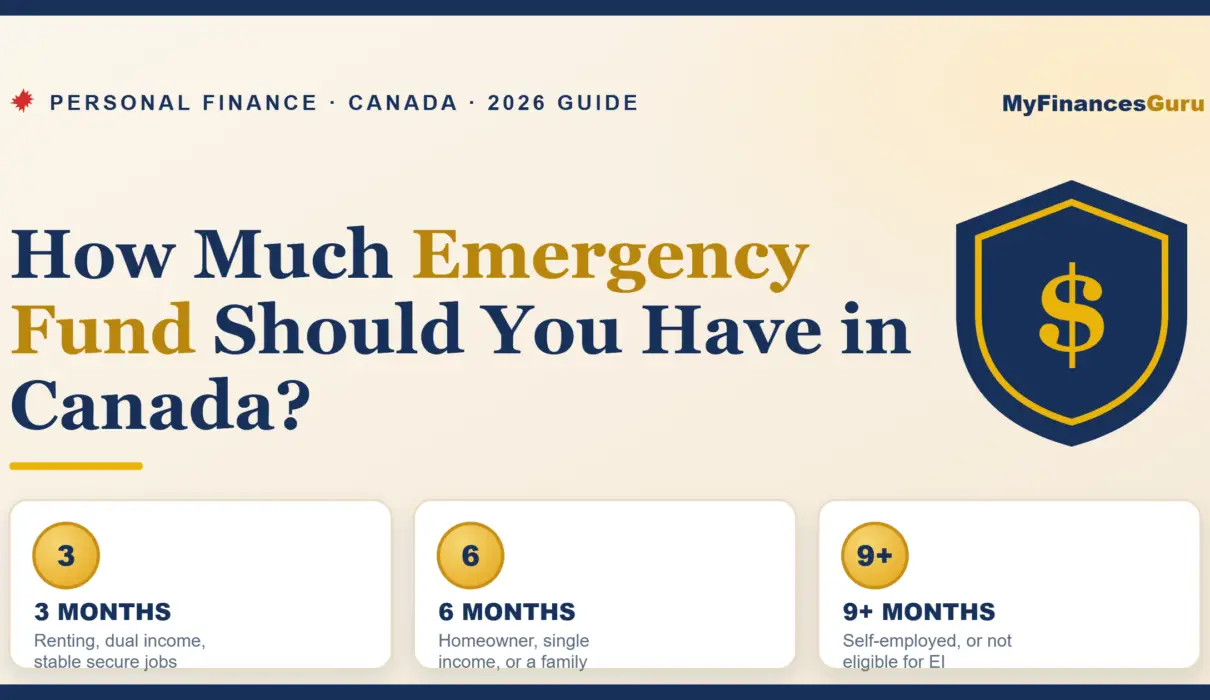
The most widely used framework in Canadian personal finance is the 3-6-9 rule, which scales the number of months you save to how risky your income and expenses are. Here is how the tiers break down.
| Your situation | Suggested emergency fund |
|---|---|
| Dual-income household, renting, stable and secure jobs, few dependents | 3 months of essential expenses |
| Homeowner, single income, a family with children, or higher fixed costs | 6 months of essential expenses |
| Self-employed, gig or commission work, irregular income, new to Canada, or not eligible for EI | 9+ months of essential expenses |
The logic is simple. The harder and slower it would be to replace your income, the bigger the cushion you need. A two-income couple renting an apartment can absorb a shock more easily than a single-income family with a mortgage and two kids, and a freelancer with no EI safety net needs the deepest buffer of all.
Notice the phrase “essential expenses.” Your emergency fund is sized to your survival budget, not your normal lifestyle budget. In a genuine emergency you would pause restaurant meals, subscriptions, and vacations, so you do not need to fund those. You do need to fund rent or mortgage, utilities, groceries, insurance, transportation, minimum debt payments, and childcare.
How to calculate your own emergency fund number
You can find your target in three steps. First, add up your essential monthly expenses only, including housing, utilities, groceries, insurance, transportation, minimum debt payments, childcare, and any medication or medical costs. Leave out anything you could cut in a crisis. Second, choose your month multiplier using the 3-6-9 tiers above, and be honest about your risk. If your income swings month to month, round up rather than down. Third, multiply. If your essential costs are $3,200 a month and you land on a six-month target, your emergency fund goal is $19,200. A savings calculator makes it easy to see how quickly regular deposits get you there.
Here is a worked example. Priya and Sam rent in Ottawa and both work stable jobs. Their essential spending is about $4,000 a month. Because they have two incomes, rent rather than own, and both qualify for EI, they choose the three-month tier, setting a target of $12,000. Their neighbour Daniel is a self-employed graphic designer with a mortgage and a young child. His essential costs are $4,500 a month, but with no EI coverage and variable income, he aims for nine months, or about $40,500. Same city, very different numbers, and both are right for their situation.
The EI factor: why Canadians can sometimes hold a little less
Employment Insurance is a real part of the Canadian safety net, and it changes the emergency-fund math in a way that guides in other countries ignore. If you lose your job through no fault of your own and you have enough insurable hours, EI can replace a portion of your income while you look for work, which softens the blow of unemployment.
That said, EI is a supplement to an emergency fund, not a replacement for it, for four reasons. It replaces only part of your former income rather than all of it, so your bills do not shrink to match. There is a waiting period before payments begin, so you need cash to bridge the first weeks. Benefits are time-limited, so a longer job search can outlast them. And crucially, many self-employed Canadians, contractors, and newer workers who have not accumulated enough insurable hours do not qualify at all. If you fall into that last group, treat yourself as being in the nine-month tier and lean toward the larger cushion, because you are your own safety net.
Where should you keep your emergency fund in Canada?
The two rules for storing an emergency fund are that the money must be safe and quickly accessible. You are not trying to grow this money aggressively; you are trying to make sure it is there, in full, on the worst day of your year. That rules out the stock market, crypto, and anything whose value can drop right when you need it.
A high-interest savings account (HISA) is the standard home for an emergency fund. Your money stays liquid, it is protected by deposit insurance, and it earns interest while it waits. As of 2026, several Canadian banks advertise promotional HISA rates around 4.5% to 4.6%, while ongoing everyday rates at online banks tend to sit lower, often in the 2.5% to 3% range. Rates move with the Bank of Canada, so check the current rate before you commit, and do not chase a teaser rate that expires in a few months if the everyday rate afterward is poor.
A Tax-Free Savings Account (TFSA) held in cash or a HISA is often the smartest wrapper of all, because the interest you earn grows tax-free instead of being taxed as income. You can withdraw from a TFSA at any time without penalty, which suits emergencies well. One nuance: when you withdraw from a TFSA, you do not get that contribution room back until January 1 of the following year, so avoid pulling money in and out repeatedly within the same year. Our TFSA Growth Calculator shows the difference the tax shelter makes over time.
A cashable or short-term GIC can hold part of a larger fund. A cashable GIC lets you break it early if you must, while a short ladder of one-year GICs can earn a bit more on money you are confident you will not need first. Keep at least the first month or two of your fund in a plain savings account so you never have to break anything in a true rush.
Whatever you choose, confirm the institution is covered by deposit insurance. CDIC protects eligible deposits up to $100,000 per insured category, per member institution, and most credit unions carry equivalent provincial coverage. If your fund is large, spreading it across two institutions keeps all of it insured. Two places to avoid: your everyday chequing account, where the money earns almost nothing and blends into spending, and any investment that can lose value, because an emergency has a habit of arriving during a market dip.
Emergency fund versus debt: which comes first?
If you are carrying high-interest debt like a credit card balance at 19% or more, saving a full six-month fund while that interest compounds is usually the wrong order. The widely taught approach is to build a starter emergency fund of about $1,000 to $2,000 first, then throw everything extra at the high-interest debt, and only after that debt is gone do you grow the fund to its full three-to-six-month size. The small starter fund stops a minor surprise from sending you back to the credit card, while the debt paydown gives you a guaranteed, tax-free return equal to the interest rate you are no longer paying. Lower-interest, longer-term debt like a mortgage is a different question, and there is a real case for building your full emergency fund before paying down or refinancing your mortgage faster.
How to build your emergency fund from zero
The gap between “I should have an emergency fund” and actually having one comes down to system, not willpower. Set a specific first milestone, such as $1,000 or one month of expenses, because a concrete target is far more motivating than a vague “save more.” Open a separate, dedicated account so the money is out of sight and psychologically off-limits, ideally at an online bank so it takes a day to transfer and you cannot raid it on impulse. Automate a transfer the day after each payday, even if it is only $25 or $50 to start, so saving happens before you can spend the money. And funnel any windfalls, such as a tax refund, GST/HST credit, work bonus, or birthday cash, straight into the fund to accelerate it.
If you need to free up room in your budget to get started, our guide to money-saving tips for a thrifty lifestyle in Canada is a good place to find the first $100 a month, and our full guide to building an emergency fund walks through the step-by-step system in more detail.
Common emergency-fund mistakes to avoid
The most frequent errors are keeping the fund in your chequing account where it quietly gets spent, investing it in stocks or crypto chasing higher returns, setting the target to your full lifestyle budget instead of your leaner survival budget, and, once the fund is built, forgetting to top it back up after you use it. Treat a withdrawal like a bill: as soon as the emergency passes, restart your automatic transfers until the fund is whole again. It is also worth revisiting your number once a year, because a raise, a move, a new baby, or a switch to self-employment can all change how much cushion you need.
The bottom line
So, how much emergency fund should you have in Canada? Aim for three months of essential expenses if you have stable, dual income and rent, six months if you own a home or support a family on one income, and nine months or more if you are self-employed or cannot rely on EI. Size it to your survival budget, keep it in a high-interest savings account or a TFSA where it stays safe and reachable, and build it automatically one payday at a time. The exact figure matters less than the habit: even a partial fund turns a financial emergency into a manageable inconvenience.
Frequently asked questions
How much emergency fund should you have in Canada?
Most Canadians should keep three to six months of essential living expenses in an accessible account. Aim for three months if you have stable, dual income and rent, six months if you own a home or have a single income and dependents, and nine months or more if you are self-employed or do not qualify for Employment Insurance.
Is $10,000 a good emergency fund?
It depends on your monthly costs. If your essential expenses are around $2,000 a month, $10,000 covers five months and is a strong fund. If they are $4,000 a month, $10,000 covers only about two and a half months, so you would want to keep building.
Where is the best place to keep an emergency fund in Canada?
A high-interest savings account or a TFSA held in cash is ideal, because your money stays safe, earns interest, and can be withdrawn quickly. Keeping it in a TFSA lets the interest grow tax-free. Avoid chequing accounts and any investment that can lose value.
Should I build an emergency fund or pay off debt first?
If you have high-interest debt like credit cards, save a small starter fund of about $1,000 to $2,000, then focus on clearing that debt before growing your fund to its full size. For low-interest debt like a mortgage, it is usually wise to build your full emergency fund first.
Does an emergency fund count if it is in my TFSA?
Yes. A TFSA is simply a tax-free wrapper, and money held in a TFSA savings account is fully liquid and withdrawable at any time, which makes it an excellent home for an emergency fund. Just remember that withdrawn contribution room only returns the following calendar year.
This article is general information, not personalized financial advice. For guidance specific to your situation, consider speaking with a licensed financial advisor.